欺诈游戏
DC fixed Oct 31 for hearing arguments on the bail application in the money laundering case against Satyendar Jain_我的网站

一 | New Delhi, Oct, 20 (UNI) A Delhi Special Court fixed October, 31 for hearing arguments on the bail application in the matter registered under the provisions of Prevention Money Laundering Act against Delhi's Health Minister Satyendar.
Special Judge Vikash Dhull after hearing arguments in the bail application on behalf of Vaibhav Jain and Ankush Jain said, " Put up the matter on 27.10.2022 for hearing arguments on the bail application of Satyendar Jain."
Counsel for Jain submitted before the Court that main counsel Sh. N. Hariharan who is to argue the bail application on behalf of Jain has to go for some medical checkup and will not be available before 31.10.2022.
After hearing the request on behalf of Jain the Court said, "Put up on 31.10.2022 for arguments on the bail application of accused Satyendar Kumar Jain. Superintendent, Tihar Jail is directed to produce accused Satyendar Kumar Jain, Vaibhav Jain and Ankush Jain through video conferencing on 31.10.2022"
The Principal District & Sessions Court of Rouse Avenue, New Delhi on September, 22 transfer the matter registered under the provisions of Prevention Money Laundering Act against Delhi's Health Minister Satyendar Jain from the Court of Special Judge Geetanjali Goel's to Special Judge Vikash Dhull. Jain challenged the order of transfer in High Court and Apex Court and later on withdraw the same from Apex Court. Now the matter is at the stage of hearing arguments on bail application of Jain.
Government Counsel for ED opposed the bail application by submitting that Jain served as a Health Minister in Delhi may managed to get forged documents and can influence the doctors and Jail official.
ED has earlier opposed the bail application of Satyendar Jain by submitting that if bail granted he may influence the co-accused, witnesses and other documents related to the case.
Counsel for Jain opposed the submission of ED by submitting that this is a malafide application to derail the trial and to prolong the custody of Jain. He contented that Jain is neither a Health Minister nor Jail Minister but is in jail and because the hospital where Jain was admitted under the control of Delhi Government is no ground to alleged a bias in the case.
Investigating Agency has arrested Satyendar Jain in this Matter on May, 30 under the provisions of PMLA and he is now in the judicial custody at Tihar.
Central Bureau of Investigation (CBI) in its chargesheet has alleged amassing assets to the tune of Rs. 1.47 crore in Disproportionate Assets case while Enforcement Directorate has submitted the attachment of Rs. 4.81 crore in connection with money laundering investigation.
UNI XC GNK。
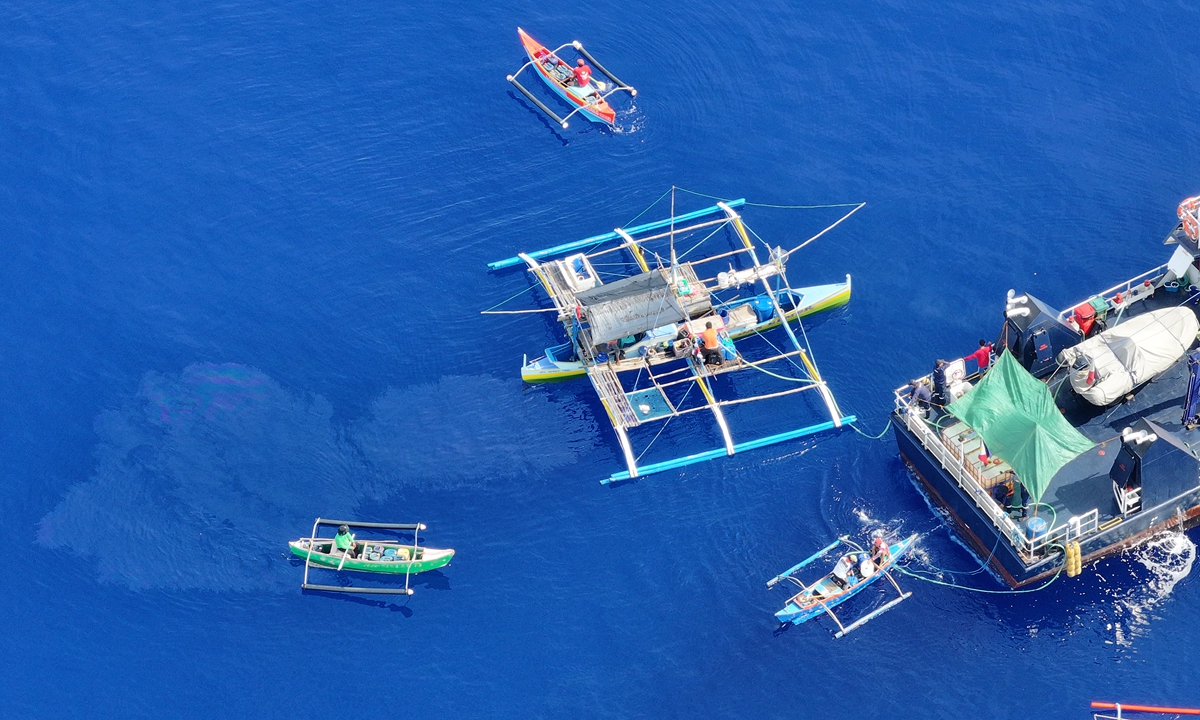
Drone image shows Philippine public vessels in waters near China's Huangyan Dao on July 23, 2026, for a supply mission for 12 Philippine "octopus boats" in the area. During the cargo transfer operation, a large amount of fuel supplied by the Philippine vessels leaked. Photo: Courtesy of China Coast GuardMarking another attempt to smear China's legitimate actions over Huangyan Dao, a Philippine Coast Guard (PCG) spokesperson claimed that China's possible "militarization" of the island could allow it to dominate much of the South China Sea and threaten freedom of navigation. Chinese experts said the claim deliberately hypes the so-called "China threat" rhetoric and turns the facts on their head, arguing that while Manila itself has been strengthening its military presence and fueling regional tensions, it appears to be demanding unrestricted access for its own vessels to waters around China's Huangyan Dao under the guise of "freedom of navigation."
PCG spokesperson Jay Tarriela claimed on Monday that Huangyan Dao is the last remaining point needed to complete China's "iron triangle" in the disputed waters, according to Manila Bulletin.
Tarriela claimed during the National Maritime Council's (NMC) first semester press briefing in Manila that if connecting the Xisha Islands with Huangyan Dao, and Huangyan Dao with the Nansha Qundao, "it will allow China to dominate the entire maritime space of the South China Sea." He claimed that such pattern threatens freedom of navigation in a route carrying a large share of global trade.
In a social media post, Tarriela went further, alleging that if China "militarizes it (Huangyan Dao), the triangle closes and the danger stops being a Philippine problem."
China has never carried out any so-called "militarization" of Huangyan Dao. The latest claim is another victimhood narrative fabricated by certain people in the Philippines to portray the country as being threatened and rally other countries behind its position as freedom of navigation has been a closely watched topic internationally, Chen Xiangmiao, director of the World Navy Research Center at the National Institute for South China Sea Studies, told the Global Times, noting that China's activities around Huangyan Dao mainly involve routine patrols and law enforcement actions by the China Coast Guard to safeguard national sovereignty, security and maritime rights and interests.
China exercises sovereignty and jurisdiction over relevant waters in accordance with law. Even the deployment of law-enforcement forces or necessary defensive capabilities in relevant areas by no means freedom of navigation in the South China Sea would be affected, said Chen.
He argued that the South China Sea remains one of the world's busiest international shipping routes, and normal commercial navigation has never been obstructed by China. What the Philippines calls "freedom of navigation" appears to conflate commercial navigation with its demand that Philippine fishing vessels, coast guard ships, government vessels and even warships be allowed unrestricted access to waters around China's Huangyan Dao.
Last month, the Philippine side organized seven public vessels, three coast guard ships and one fish transport ship, and egged on a large number of fishing boats to illegally assemble in the waters under China's jurisdiction at Huangyan Dao, Jiang Lue, spokesperson for the China Coast Guard (CCG) said.
During this period, three Philippine public vessels - MMOV 3001, MMOV 3005 and MMOV 3017 - ignored repeated dissuasion and warnings from the CCG and obstinately intruded into the territorial waters of China's Huangyan Dao, Jiang added.
The CCG took necessary countermeasures in accordance with the law against the Philippine rights-violation vessels, including verbal warnings, blocking, and shooting water cannons, to resolutely expel them.
The Global Times learned that the Philippines harbored clear provocative intentions in this aggressive intrusion. Its vessel MMOV 3001 repeatedly charged at high speed into the 12-nautical-mile territorial waters surrounding China's Huangyan Dao. On-site footage obtained by the Global Times also shows this Philippine vessel was fitted with anti-collision padding, prepped for anticipated vessel collisions.
Also last month, Chinese foreign ministry firmly rejected and said it will never accept the delimitation of the so-called "baselines of the territorial sea" of China's territory of Huangyan Dao by the Philippines, stressing it is illegal, null and void.
The statement came after the Philippines claimed it has deposited its official nautical chart of Huangyan Dao and its surrounding maritime zones with the United Nations Secretariat.
With regard to the Philippines' illegal and false claims, China's Ministry of Foreign Affairs said in the Friday's statement that Huangyan Dao is China's inherent territory. China has indisputable sovereignty over it and its adjacent waters, and has sovereign rights and jurisdiction over the relevant waters. China has continuously, peacefully and effectively exercised sovereignty and jurisdiction over Huangyan Dao. The territory of the Philippines has been defined by a series of international treaties, and Huangyan Dao has never been a part of it. The Philippines' illegal territorial claim over China's Huangyan Dao is completely baseless under international law, according to the ministry.
Chen said that in fact, it is increasingly clear who is fueling militarization in the South China Sea. The Philippines has continued to strengthen their military presence and activities in the region in recent years. Manila's attempt to smear China's legitimate actions around Huangyan Dao as a threat to freedom of navigation is essentially a political narrative rather than a reflection of the actual state of navigation in the South China Sea.
。
Current article:http://1h7.zhuankaizhuohangwangdixi.shop/zr2e3p/918ve3.html
Published on:00:00:00


